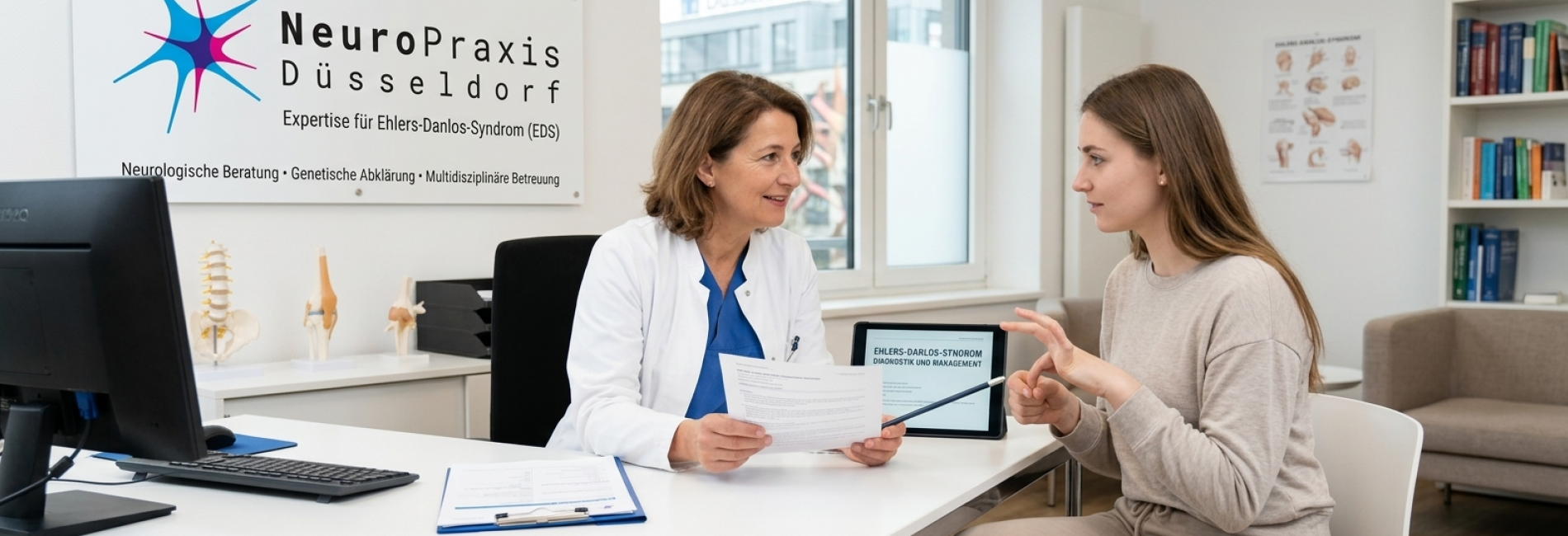
Ehlers-Danlos Syndrome (EDS) at Neuro Praxis Düsseldorf
EDS: Neurological Expertise and Interdisciplinary Care
Ehlers-Danlos syndrome (EDS) refers to a group of rare, mostly inherited connective tissue disorders. Depending on the subtype, possible features include excessive joint mobility, increased tissue fragility, and changes in the skin.
Hypermobile Ehlers-Danlos syndrome (hEDS) is of particular relevance. In affected patients, musculoskeletal problems may be accompanied by symptoms involving the nervous system and, in particular, the regulation of the autonomic nervous system.
What neurological symptoms can occur with EDS?
Symptoms vary considerably from person to person. Possible neurological or autonomic symptoms include:
- Dizziness and circulatory problems when standing up
- Palpitations or a rapid heart rate and pronounced orthostatic symptoms
- Syncope or presyncope
- Reduced physical exercise tolerance
- Severe fatigue
- Disturbances in temperature regulation and sweating
- Abnormal sensations, burning sensations, or neuropathic pain
- Headaches
- Sleep disturbances
In particular, orthostatic intolerance or postural orthostatic tachycardia syndrome (POTS) may occur in association with pronounced hypermobility or Ehlers-Danlos syndrome.
In patients with corresponding symptoms, involvement of the small nerve fibers in the form of small fiber neuropathy may also be relevant as part of the differential diagnosis.
How do we assess patients with EDS?
Our focus is not solely on establishing a diagnosis of Ehlers-Danlos syndrome, but rather on carefully evaluating the neurological symptoms that may be associated with the condition.
The investigations that are appropriate therefore always depend on the individual symptoms and the medical findings already available.
If there are indications of autonomic nervous system dysfunction, for example, comprehensive autonomic function testing, including cardiovascular and tilt-table testing, may be appropriate. If symptoms suggest involvement of the small nerve fibers, additional methods of small fiber diagnostics may also be considered.
Our aim is not to assume that an existing diagnosis explains every symptom. Particularly in complex conditions, it is important to determine which symptoms can be objectively documented, which neurological functional systems are affected, and whether additional or alternative causes may be present.
Does Neuro Praxis Düsseldorf diagnose Ehlers-Danlos syndrome itself?
Our primary focus is on neurological diagnostics, particularly the assessment of autonomic nervous system disorders. If additional evaluation by specialists in human genetics, rheumatology, or orthopaedics is required, we work closely with specialised colleagues in these disciplines as needed.
If you have already been diagnosed with Ehlers-Danlos syndrome or have pronounced hypermobility and are also experiencing neurological or autonomic symptoms, we investigate whether and to what extent the nervous system is involved in your symptoms.
For these complex conditions, too, we place great importance on a comprehensive initial medical history, careful review of existing medical records, and an individually tailored diagnostic assessment.